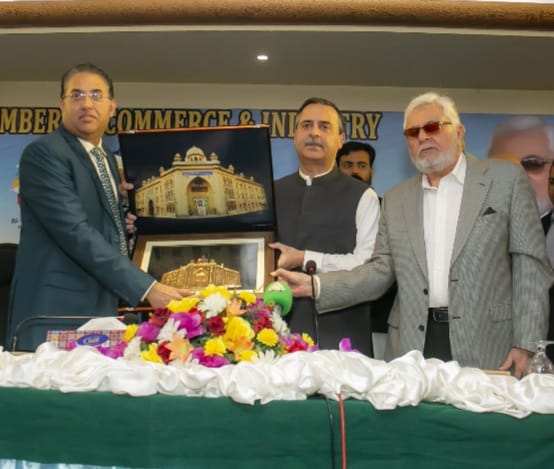
Karachi(Cliff News)Federal Minister for Maritime Affairs Muhammad Junaid Anwar, while highlighting the tremendous potential in Pakistan’s shipping and maritime sector, urged the business community to invest in shipping, as global trade volumes are expected to grow significantly in the coming years.Speaking at a meeting during his visit to the Karachi Chamber of Commerce and Industry on Tuesday, the Minister invited the business community to bring feasible business proposals to utilize KPT’s available land, proposing that the port could act as a strategic partner with investors. “We have 140 acres of land where we can jointly develop an Industrial Park”, he said, adding that the government welcomes both local and foreign investors to participate in the development of Pakistan’s most modern terminal. He encouraged the private sector to form a consortium, while assuring that the government will provide land and the private sector will operate the terminal.
Chairman Karachi Port Trust (KPT) Rear Admiral Ateeq ur Rehman Abid, Chairman, Port Qasim Authority Rear Admiral (R) Syed Moazzam Ilyas, Chairman Businessmen Group Zubair Motiwala, Vice Chairmen BMG Anjum Nisar, Jawed Bilwani and Tariq Yousuf, President KCCI Muhammad Rehan Hanif, Senior Vice President KCCI Muhammad Raza, Vice President Muhammad Arif Lakhani, Chairman Maritime Affairs Subcommittee Junaid Mehmood, Former President KCCI/ Trustee KPT Abdullah Zaki and KCCI Managing Committee Members along with General Managers of KPT and others were also present on the occasion.
Junaid Chaudhry appreciated KCCI’s longstanding role in representing the business and industrial community of Karachi, and acknowledged the deep institutional connection between shipping agents and KCCI. He assured that as a neutral mediator, he would make every possible effort to find a balanced and mutually beneficial way forward to address the concerns of both stakeholders, the business community and the shipping agents.
He declared that the Ministry of Maritime Affairs stands shoulder to shoulder with the business community, stating that if the Karachi Chamber submits a complaint against any terminal or port-related entity, the Ministry will fully support its legitimate demands.
He also highlighted the challenges faced by the Pakistan National Shipping Corporation (PNSC), noting that it alone cannot bear the burden of reducing freight-related losses. He informed that the government plans to increase PNSC’s fleet by 50 percent, with agreements for five new vessels already in final stages. While PNSC initially aimed to expand to 30 vessels within three years, he directed that this target be achieved within one year, emphasizing the need for rapid modernization and expansion of the national fleet.
He stated that upon assuming charge of the Ministry, he made a firm decision not to allow real estate dealings on port lands, ensuring that port areas are used strictly for trade, logistics, and industrial development.Junaid Chaudhry noted that if Pakistan’s industrial and trade capacity doubles, the ports’ operational capacity will automatically reach 100 percent, adding that the government’s long-term vision is to achieve full port capacity utilization by 2047.
Highlighting developments in Gwadar, he reminded that the port’s establishment was a demand of the people of Gwadar, and it will only thrive once the business community establishes factories and industries there. He cited opportunities in tuna fish processing, date production, and livestock exports to China, noting that the situation in Gwadar is now better and more secure than Karachi, with the Ministry ensuring full security arrangements for investors.
The Minister revealed that the government plans to establish a Pakistan maritime industrial zone on a 700-acre land where “Made in Pakistan” ships will be built, supported by an on-site steel melting unit and a ship-breaking yard.
Chairman BMG Zubair Motiwala, in his remarks, emphasized the urgent need for constructing a bypass road for Karachi, Pakistan’s main port city, to ease the worsening traffic congestion and frequent accidents caused by heavy vehicular movement from ports to upcountry. He noted that while every major city in Pakistan has a bypass, Karachi, the nation’s economic and maritime hub, remains deprived of this basic infrastructure facility, which is vital for efficient cargo movement to and from the ports.
He estimated that the construction of a dedicated bypass corridor could reduce traffic congestion by nearly 70 percent, significantly improving logistics efficiency and reducing accidents. He proposed that the necessary funding, estimated at around Rs.70 to 80 billion, could be mobilized from the Sindh government’s Infrastructure Development Cess, adding that the Government of Sindh presently holds more than Rs.250 billion in cess funds, which should be utilized for such crucial infrastructure development directly benefiting the trade and industrial sectors.Zubair Motiwala also expressed concern over the decline of PNSC, observing that it was once a highly efficient and profitable institution but has been severely weakened due to bureaucratic mismanagement. He suggested that if PNSC vessels were leased to the private sector, it would not only enhance operational efficiency but also contribute meaningfully to Pakistan’s maritime and economic growth.
Vice Chairman BMG Jawed Bilwani, while expressing his views, stated that it was truly encouraging to hear Maritime Minister’s constructive thoughts and concern for the industrial sector. He pointed out that Karachi’s industries are facing a multitude of challenges, including severe shortages and high costs of gas and electricity, which have created enormous hurdles for industrial operations.He remarked that the cost of energy in Pakistan is significantly higher than in the countries to which Pakistani exporters sell their goods, making it extremely difficult for local industries to remain competitive in international markets. “How can industries continue to operate merely on patriotic slogans when the basic enablers for production are unaffordable”, he questioned.He emphasized that 654 plots purchased in Port Qasim over two decades ago are designated industrial plots, yet purchasers continue to be deprived of physical possession and the ability to develop their investments. He urged the Minister to take immediate notice and facilitate an amicable resolution, saying that the state should either deliver possession to lawful purchasers or provide fair and transparent compensation where possession cannot be granted.Earlier, President KCCI Muhammad Rehan Hanif, while welcoming the Maritime Minister, appreciated the efforts of Maritime Minister, under whose leadership land worth Rs.150 billion at the Karachi Port was successfully retrieved after years of encroachment. He highlighted that despite this progress, several serious operational challenges continue to hinder smooth port and terminal operations. The absence of pre-arrival parking facilities at KPT has created congestion and delays, while daily backlogs at the Karachi International Container Terminal (KICT) are causing immense difficulties for importers and traders.He lamented that the business community has long endured the arbitrary practices and exploitative conduct of shipping agents, stressing that it is now imperative to rein in their unregulated operations. He reiterated KCCI’s demand for the establishment of a regulatory authority to monitor and control the affairs of shipping agents and freight forwarders, ensuring transparency and fairness in their dealings.President KCCI further pointed out that despite many terminals already operating at full capacity, shipping lines are still being permitted to dock vessels, resulting in severe congestion and inefficiencies. He also drew attention to the unjustified foreign exchange practices, noting that some shipping lines are openly charging as high as Rs.296.20 per US dollar, and in some cases, even higher than the hawala/hundi market rates. “If not the official rate of the State Bank, at least the open market exchange rate should be applied”, he emphasized.He urged the Ministry of Maritime Affairs to include a representative of the Karachi Chamber on the Board of Port Qasim Authority and PNSC to ensure transparency, accountability, and inclusion of the business community in policy decisions.